One Year Later: The State of Queer Country Music in Trump 2.0
It's been just over one year since Trump has taken office: as we all negotiate American identity, how have queer country artists fared in the new, oppressive regime?
Independent journalism like this takes time and money! Normally I'd put a paywall on this article, but it's too important. Please consider signing up or becoming a paid subscriber!
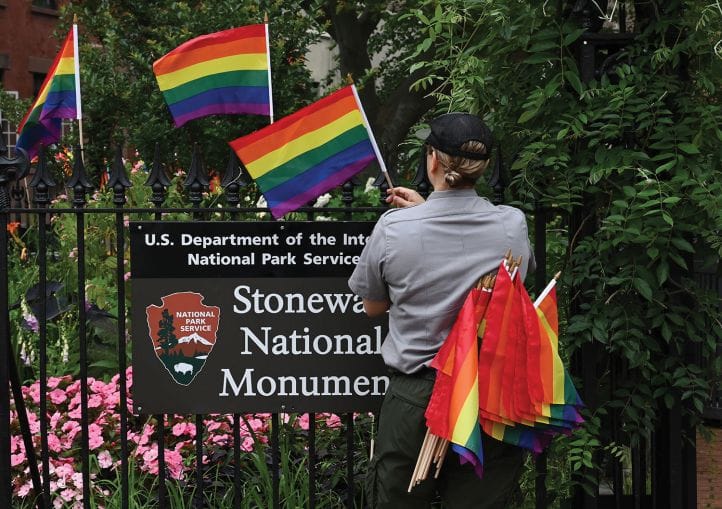
Just over a year since President Trump took office, and it feels like it's been a lifetime. We are once again forced to reckon with what America means – how to force it to live up to its promises, or if this country's evils are simply baked into the foundation. This is the task of every generation, and during every presidential administration, but few presidents have been as nakedly corrupt and vicious. I don't need to recap everything that has occurred in the seeming decade that has passed since January 1, 2025 – but for the purposes of this article, the Trump administration has set the queer community, and trans people, in its sights. Earlier this week, the National Parks Service removed the Pride flag from the Stonewall National Monument, and just today, the Department of Health is referring four major LGBTQIA+ clinics for investigation -- threatening their ability to provide gender-affirming care.
Even as people take the streets in Chicago, Minneapolis, Los Angeles, and beyond to defend people deemed un-American by the government, that struggle to define what it means to be American is happening across cultural fields as well – and none more so than country music. While country music and its corporate infrastructure are widely assumed to be beacons of conservatism, queer artists are still staking their claim in the genre – and, in doing so, our collective claim on American identity and culture. But what, if anything, has changed in Nashville since Trump has taken office and his minions of unleashed their overt white nationalism upon Americas most hallowed institutions?
Risky Business
Popular singer Chris Housman comfortably takes up space on the pop side of country music, penning radio-friendly songs about chilling by the lake...as well as political anthems. Housman caught international attention with "Blueneck" in 2020, a hopeful song of anti-racist Southern Pride in the wake of the mass uprising to protest George Floyd's death. Housman has noticed a significant change since."
At the time it felt like this cool moment where people of color and queer artists are finally getting the attention they deserve and the spotlight they deserve, or at least becoming a part of the conversation. It's a little bit to be expected that maintaining that excitement and that level of interest, I guess, is tough, whether that's one artist or a whole community of artists."
Yet, according to Housman's publicist, few outlets are open to explicitly covering Diversity Equity and Inclusion (DEI) in country music. Housman summarizes his publicist's analysis: "It's considered a risk now."
Limited Opportunities Now Shrinking
Hunter Kelly, the former host of Apple Music's Proud Radio, found this to be the case as well. The show highlighted LGBTQIA+ artists in country music, and was abruptly canceled in September 2024, shortly before Election Day. Kelly had never been shown any streaming data during the show's four-year duration, but had never had conversations with producers indicating that the company had concerns about the show. Tim Cook, along with other major tech CEOs, attended Trump's inauguration.
When Kelly attempted to shop the show, or one like it, to other networks, he was told that it would be a "non-starter."
Kelly now writes the Substack newsletter Untethered Southerner, a project he began after leaving Nashville for Chicago. As Kelly sees it, the mainstream country industry has always gatekept queer artists -- but now there are even more locks on the gate.
"When Charlie Kirk was assassinated, that really filled in a lot of blanks for me on a lot of the people who weren't outwardly MAGA or outwardly pro-Trump, but were tied into this movement through their faith. The best that they could do was just be quiet when I was asking for help with queer issues, because they're getting the message from their faith community that queer issues are sinful, queer issues are decaying in the country."
It's no coincidence that a number of artists like Anne Wilson and Brandon Lake have recently crossed over into pop country after previously making their names in Christian Contemporary Music. Nashville may be famous for country music, but it is also the beating heart of CCM.
While resources pour into backing these artists, LGBTQIA+ institutions struggle. Nashville Pride, the city's annual festival, lost a number of sponsors and staged a (successful) fundraiser to keep the festival going this year. But festivals in smaller communities may face difficult choices this June -- which could be catastrophic for independent queer artists.
"Pride festivals have been one of the main sources of income for myself and other queer artists."
Similarly, mainstream country institutions -- and the few out LGBTQIA+ artists who have been let into them -- seem to be shying away from overt representation. In spite of being the first major country festival to prominently feature a stage of LGBTQIA+ artists in 2022, CMA Fest did not continue its Country Proud stage this year.
"There were some people in the queer community who signed off on the idea that there shouldn't be a special stage because it makes it seem like it has to be some kind of special thing for LGBTQIA+ artists to have representation," Kelly reported. "I don't know that those people really understood what they were asking for, because I think that just gave the CMA an excuse to erase queer artists."
While there were queer artists in this year's lineup, Kelly notes that, without the Country Pride stage, that number is much smaller.
While Housman says he has not experienced any direct discrimination, he knows that his experience is not representative of all LGBTQIA+ artists.
"My heart just goes out to all trans and non-binary artists, because they're literally just trying to survive right now. The climate feels truly dangerous right now, primarily because of this administration."
Similarly, the resources dedicated to diversifying the music industry -- promoters, publishers, songwriters, management, A&R; you know, the people backstage -- have also shrunk. Equal Access Development Program, which has mentored four cohorts of marginalized artists and management interns, has lost a significant amount of corporate funding. Executive Directory Tiffany Provenzano cautions that it is difficult to know if these losses are a direct result of "rollbacks in DEI support," but the impact on the program's ability to mentor is clear. The 2025 cohort is now four people instead of six, and the program is now fundraising directly from the public via donations and merch via NB Goods.
In 2026, Equal Access will provide continued support to previous cohort members and fundraise for a new cohort in 2027. Although the material resources are scarce, Provenzano has found that an increased number of people are coming forward to donate their time to the program. In other words, the individual will to create a country music that represents this country is there, but institutional support is lacking.
Housman and publicist Becky Parsons of Found Sound Media were members of the 2024 cohort.
"I have been noticing that these artists move to Nashville and have basically been sold this dream that all they have to do is move to town, and play all the writer's rounds, and meet all the people, and if they really want it, and if they push really, really hard, that eventually somebody's gonna notice, and somebody's gonna give them a record deal," observes Parsons.
"That is just not the case for diverse artists, and I don't think it really ever has been. I can think of artists that were signed to labels during the 2020 push for more artists of color to be receiving deals at major labels, and then a lot of those artists then got dropped in the 2 to 3 to 4 years following 2020, because those labels didn't didn't really know how to meet them where they were at."
Similarly, Parsons observes that as layoffs hit the music industry, people who are the least senior -- often those hired since 2020 during that push for more diversity -- have been let go, which further compounds the difficulties diverse artists face in being understood by the industry.
"If those artists don't fit into the boxes and the models that the machine understands how to market effectively, they don't really know what to do with them, and instead of owning up to that, and educating themselves, and maybe even allowing their own staff to start being more creative with how they approach the rollout of these genre-expansive projects, it would be different. From the outside looking in, I find that label teams are underfunded, under-hired, and understaffed. You can't really even blame the individual people working at the labels. You have to look at it from who's running the labels? Who's making the major decisions?"
Often, those people don't want to make the hard calls.
"It's a repeated pattern that our industry won't break until it wants to break it. I think that this administration emboldened a lot of gatekeepers in our industry who never really wanted to expand the playing field in the first place."
"Be Undeniable"
Even though there is a sense that the opportunities from the first half of the decade have slipped away, the renewed horrors of the Trump administration seem to be pushing individuals to take on more of a stand.
"There have been more people speaking out about immigration policies -- and I think it's definitely going to continue to affect the music industry, just on so many different facets from touring to everything," notes Provenzano. "I think sometimes as things are getting worse, people get more comfortable recognizing that like they do have a platform and they're using it to speak out."
Kelly, who left Nashville because he feared for his safety, has a more measured approach. "There's part of me that feels defeated -- but there's also part of me that's like the tube is out of the toothpaste and these artists have been here and have done what they've done and there's no going back."
Indeed, Housman is doubling down. His recent song "Up and Down" is a near-Marxist reading of political struggle that'll get your toes tapping -- and has garnered millions of views on TikTok, as well as netted Housman several hundred thousand followers.
"Unfortunately, I feel like I thrive in chaos," Housman jokes. "It does feel like a song can go a long way further than a [political] Instagram story post of something where you're just in an echo chamber."
Parsons notes that, right now especially, music is informing the resistance. Found Sound Media specializes in working with diverse artists and Parsons is encouraging her clients to stay true to themselves.
"Create art that is undeniable. Spend time refining your craft so deeply that you have found what it is that makes you unique from every other artist. That is the only way that an independent artist will make it."